

Goat Feeds

Pygmy Goat Mix
A wholesome feed with higher fibre levels and dried fruit and vegetables which mimics the Pygmy goat's natural diet as closely as possible.
Available in 15kg bags
| Oil 4.5% | Protein 13.5% | Fibre 12.0% |
| Crude Protein: | 13.5% |
| Crude Fibre: | 12.0% |
| Calcium: | 1.2% |
| Phosphorous: | 0.4% |
| Crude Oils and Fats: | 4.5% |
| Crude Ash: | 8.0% |
| Sodium: | 0.5% |
| Magnesium: | 0.16% |
Pygmy Goat Mix Composition and Nutritional Additives
PYGMY GOAT MIX Product Code 2410-15
Smallholder Range, IP25 7SD Tel: 01362 822902
A COMPLEMENTARY FEED for GOATS
Composition
Barley, Peas, Nutritionally Improved Straw, Linseed, Maize, Wheat Feed, Beans, Oats, Alfalfa, Calcium Carbonate, Expelled Soya Oil, Grass Meal, Salt, Carrot, Apple, Mint, Yeast, Pineapple, Di-Calcium Phosphate, Fenugreek
Nutritional Additives (per kg)
Vitamins: E672 Vitamin A: 6k iu (as retinol acetate); E671 Vitamin D3: 1.8k iu (as cholecalciferol); E3a700 Vitamin E: 45mg (as all-rac-alpha-tocopheryl acetate)
Trace elements: 47mg Ferrous Sulphate Monohydrate (E1-Iron); 50mg Zinc Oxide (E6-Zinc); 42mg Manganous Oxide (E5-Manganese); 0.31mg Calcium Iodate Anhydrous (E2-Iodine); 0.29mg Sodium Selenite (E8-Selenium); 8.3mg Cupric Chelate of Glycine, Hydrate (E4-Copper)
- Smallholder Range only source identity preserved (Hard IP) Non-GM ingredients.
- Smallholder Range feeds are made from natural ingredients which can result in the feed changing colour slightly through the seasons.
Establishment No: GB226 0005
UFAS 1
Pygmy Goat Mix Feeding Instructions
Instructions for use
Pygmy goats thrive on routine so try to feed them at the same time each day. It is advisable to feed them twice per day – so split the mix evenly between each meal. The rest of their daily diet should be made up of good quality hay, which can be made available at all times for them to help themselves. Make sure that clean, fresh water is also available at all times. Feed between 80 to 270g per day depending on size, and condition.
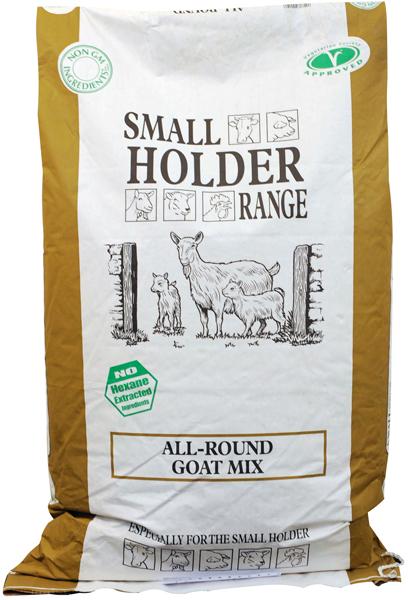
All-Round Goat Mix
A nutritious higher energy goat mix suitable for milk producing and breeding goats, or as a maintenance diet for mature goats.
Available in 20kg bags
| Oil 4.5% | Protein 15.0% | Fibre 6.0% |
| Crude Protein: | 15.0% |
| Crude Fibre: | 0.6% |
| Calcium: | 1.2% |
| Phosphorous: | 0.45% |
| Crude Oils and Fats: | 4.5% |
| Crude Ash: | 8.0% |
| Sodium: | 0.6% |
| Magnesium: | 0.2% |
All Round Goat Mix Composition and Nutritional Additives
ALL ROUND GOAT MIX Product Code 2430-20
Smallholder Range, IP25 7SD Tel: 01362 822902
A COMPLEMENTARY FEED for GOATS
Composition
Barley, Peas, Linseed, Wheat Feed, Maize, Beans, Oats, Molasses, Calcium Carbonate, Salt, Grass Meal, Yeast, Mint, Fructo-oligosaccharides
Nutritional Additives (per kg)
Vitamins: E672 Vitamin A: 6.25k iu (as retinyl acetate); E671 Vitamin D3: 2.0k iu (as cholecalciferol); E3a700 Vitamin E: 20mg (as all-rac-alpha-tocopheryl acetate)
Trace elements: 33mg Ferrous Sulphate Monohydrate (E1-Iron); 28mg Zinc Oxide (E6-Zinc); 32mg Manganous Oxide (E5-Manganese); 0.22mg Sodium Selenite (E8-Selenium)
- Smallholder Range only source identity preserved (Hard IP) Non-GM ingredients.
- Smallholder Range feeds are made from natural ingredients which can result in the feed changing colour slightly through the seasons.
Establishment No: GB226 0005
UFAS 1
All Round Goat Mix Feeding Instructions
Instructions for use
Hay or roughage will form the basis of the diet. Adult goats will usually eat at least 1-2kg of hay a day, and milkers will often need nearer 3.5kg of hay a day. Goats are highly individual and these are only guidelines – adjust the quantity fed to maintain each goat in the best condition. Make any changes slowly and introduce concentrate feeds gradually. It is usual to split the total amount into two or three feeds.
Maintenance – adult goats that are not milking will usually need 0.5-1.0kg of mix per day.
Milking and In Kid Goats – Introduce Dairy Goat Mix 1-2 weeks before the kids are due to be born. Start with just a handful and increase gradually so that by the day of the birth you are feeding 0.5kg a day. After the birth, slowly increase the quantity of Dairy Goat Mix to about 2kg a day. A milker producing 4.5 litres (a gallon) a day will usually require 2kg of mix. For those producing more milk than this, it may be necessary to increase the amount fed up to 3kg, although not all goats will eat this much.
Kids – the newborn kid will get all its nourishment from its mother’s milk. Introduce feed gradually and in small amounts. By the time they are two weeks old, kids will already be starting to nibble at solid food. Offer small amounts of mix for them to pick at, as well as good quality hay. This can gradually be increased so that by the time they are weaned (usually at about three months) they are eating at least 0.4kg of mix a day.

Herbal Goat Mix
A herbal mix with alfalfa, which has been found to be especially suited to shy feeders and goats under stress.
Available in 20kg bags
| Oil 4.0% | Protein 13.7% | Fibre 6.0% |
| Crude Protein: | 13.7% |
| Crude Fibre: | 6.0% |
| Calcium: | 1.2% |
| Phosphorous: | 0.45% |
| Crude Oils and Fats: | 4.0% |
| Crude Ash: | 7.5% |
| Sodium: | 0.5% |
| Magnesium: | 0.2% |
Herbal Goat Mix Composition and Nutritional Additives
HERBAL GOAT MIX Product Code 2433-20
Smallholder Range, IP25 7SD Tel: 01362 822902
A COMPLEMENTARY FEED for GOATS
Composition
Barley, Peas, Beans, Linseed, Molasses, Maize, Wheat Feed, Oats, Alfalfa, Calcium Carbonate, Grass Meal, Salt, Di-calcium Phosphate, Expelled Soya Oil, Mint, Yeast, Garlic, Mixed Herbs, Fructo-oligosaccharides
Nutritional Additives (per kg)
Vitamins: E672 Vitamin A: 6.25k iu (as retinyl acetate); E671 Vitamin D3: 2.0k iu (as cholecalciferol); E3a700 Vitamin E: 20mg (as all-rac-alpha-tocopheryl acetate)
Trace elements: 33mg Ferrous Sulphate Monohydrate (E1-Iron); 28mg Zinc Oxide (E6-Zinc); 32mg Manganous Oxide (E5-Manganese); 0.22mg Sodium Selenite (E8-Selenium);
- Smallholder Range only source identity preserved (Hard IP) Non-GM ingredients.
- Smallholder Range feeds are made from natural ingredients which can result in the feed changing colour slightly through the seasons.
Establishment No: GB226 0005
UFAS 1
Herbal Goat Mix Feeding Instructions
Instructions for use
Hay or roughage will form the basis of the diet. Adult goats will usually eat at least 1-2kg of hay a day, and milkers will often need nearer 3.5kg of hay a day. Goats are highly individual and these are only guidelines – adjust the quantity fed to maintain each goat in the best condition. Make any changes slowly and introduce concentrate feeds gradually. It is usual to split the total amount into two or three feeds.
Maintenance – adult goats that are not milking will usually need 0.5-1.0kg of mix per day.
Milking and In Kid Goats – Introduce Dairy Goat Mix 1-2 weeks before the kids are due to be born. Start with just a handful and increase gradually so that by the day of the birth you are feeding 0.5kg a day. After the birth, slowly increase the quantity of Dairy Goat Mix to about 2kg a day. A milker producing 4.5 litres (a gallon) a day will usually require 2kg of mix. For those producing more milk than this, it may be necessary to increase the amount fed up to 3kg, although not all goats will eat this much.
Kids – the newborn kid will get all its nourishment from its mother’s milk. Introduce feed gradually and in small amounts. By the time they are two weeks old, kids will already be starting to nibble at solid food. Offer small amounts of mix for them to pick at, as well as good quality hay. This can gradually be increased so that by the time they are weaned (usually at about three months) they are eating at least 0.4kg of mix a day.

Goat Mix (Dry)
An unmolassed high energy mix suitable for goats of all ages, goats in the latter stages of pregnancy and breeding goats.
Available in 20kg bags
| Oil 4.0% | Protein 14.0% | Fibre 5.0% |
| Crude Protein: | 14.0% |
| Crude Fibre: | 5.5% |
| Calcium: | 1.2% |
| Phosphorous: | 0.45% |
| Crude Oils and Fats: | 4.0% |
| Crude Ash: | 7.0% |
| Sodium: | 0.5% |
| Magnesium: | 0.2% |
Dry Goat Mix Composition and Nutritional Additives
DRY GOAT MIX Product Code 2431-20
Smallholder Range, IP25 7SD Tel: 01362 822902
A COMPLEMENTARY FEED for GOATS
Composition
Barley, Peas, Linseed, Maize, Oats, Wheat Feed, Beans, Calcium Carbonate, Grass Meal, Salt, Wheat Syrup, Di-Calcium Phosphate, Yeast, Fructo-oligosaccharides
Nutritional Additives (per kg)
Vitamins: E672 Vitamin A: 6.25k iu (as retinyl acetate); E671 Vitamin D3: 2.0k iu (as cholecalciferol); E3a700 Vitamin E: 20mg (as all-rac-alpha-tocopheryl acetate)
Trace elements: 33mg Ferrous Sulphate Monohydrate (E1-Iron); 28mg Zinc Oxide (E6-Zinc); 32mg Manganous Oxide (E5-Manganese); 0.22mg Sodium Selenite (E8-Selenium)
- Smallholder Range only source identity preserved (Hard IP) Non-GM ingredients.
- Smallholder Range feeds are made from natural ingredients which can result in the feed changing colour slightly through the seasons.
Establishment No: GB226 0005
UFAS 1
Dry Goat Mix Feeding Instructions
Instructions for use
Hay or roughage will form the basis of the diet. Adult goats will usually eat at least 1-2kg of hay a day, and milkers will often need nearer 3.5kg of hay a day. Goats are highly individual and these are only guidelines – adjust the quantity fed to maintain each goat in the best condition. Make any changes slowly and introduce concentrate feeds gradually. it is usual to split the total amount into two or three feeds.
Maintenance – adult goats that are not milking will usually need 0.5-1.0kg of mix per day.
Milking and In Kid Goats – Introduce Dairy Goat Mix 1-2 weeks before the kids are due to be born. Start with just a handful and increase gradually so that by the day of the birth you are feeding 0.5kg a day. After the birth, slowly increase the quantity of Dairy Goat Mix to about 2kg a day. A milker producing 4.5 litres (a gallon) a day will usually require 2kg of mix. For those producing more milk than this, it may be necessary to increase the amount fed up to 3kg, although not all goats will eat this much.
Kids – the newborn kid will get all its nourishment from its mother’s milk. Introduce feed gradually and in small amounts. By the time they are two weeks old, kids will already be starting to nibble at solid food. Offer small amounts of mix for them to pick at, as well as good quality hay. This can gradually be increased so that by the time they are weaned (usually at about three months) they are eating at least 0.4kg of mix a day.
Need Help?
Please Call Our Helpline
If you are having feed problems we’re here to help and won’t blind you with science.